



Quick Summary
Accurate conversion tracking is the backbone of agency success. Learn how to implement GA4, Google Ads, and call tracking to prove ROI and scale client results with confidence.
Table of Contents
Introduction: Why Conversion Tracking Matters for Agencies
For agencies, results matter more than promises. Without proper conversion tracking, it’s impossible to prove performance, optimise campaigns, or justify monthly retainers. Clicks and impressions alone no longer convince clients.
To measure real business impact, agencies need a complete tracking system that captures online actions, paid campaign performance, and phone leads. This guide explains how agencies can set up GA4, Google Ads conversion tracking, and call tracking in a clear, structured way across multiple client accounts. This data-driven approach to proving performance is how leading digital agencies differentiate themselves from competitors who rely on vanity metrics and ambiguous reporting.
To measure real business impact, agencies need a complete tracking system that captures online actions, paid campaign performance, and phone leads. This guide explains how agencies can set up GA4, Google Ads conversion tracking, and call tracking in a clear, structured way across multiple client accounts. This data-driven approach to proving performance is how leading digital agencies differentiate themselves from competitors who rely on vanity metrics and ambiguous reporting.
The Three Essentials of Conversion Tracking
A reliable tracking setup is built on three core components, each serving a unique purpose.
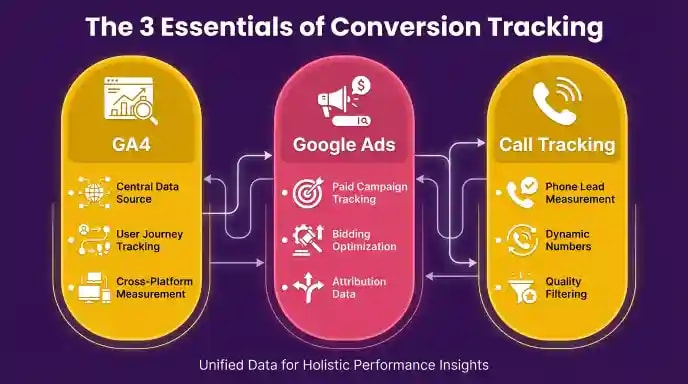
Google Analytics 4 (GA4): The Central Data Source
GA4 tracks how users behave on a website across all traffic sources. It shows where users come from, what they do, and which actions lead to conversions. GA4 should always be the single source of truth for overall performance.
Google Ads Conversion Tracking: Paid Campaign Optimisation
Google Ads tracking tells the ad platform which actions matter most. When conversions are tracked correctly, Google’s bidding algorithms optimise campaigns for leads or sales instead of clicks. Agencies managing multiple PPC accounts require systematic conversion tracking protocols to ensure consistent campaign optimization across all client portfolios.
Call Tracking: Measuring High-Intent Leads
Many service businesses rely on phone calls. Call tracking assigns unique phone numbers to traffic sources, allowing agencies to see which campaigns generate real conversations and qualified leads.
Step-by-Step Conversion Tracking Setup for Agencies
Step 1: Define What a Conversion Means
Before any technical setup, agencies must clarify:
- Primary conversions (form submissions, calls, purchases)
- Secondary conversions (downloads, appointment bookings)
- Estimated value per lead or sale
This ensures reporting aligns with business goals, not vanity metrics.
- Primary conversions (form submissions, calls, purchases)
- Secondary conversions (downloads, appointment bookings)
- Estimated value per lead or sale
This ensures reporting aligns with business goals, not vanity metrics.

Step 2: Use Google Tag Manager for Clean Implementation
Google Tag Manager (GTM) allows agencies to manage all tracking without touching website code repeatedly.
Key actions:
- Install GTM across the site
- Add GA4 configuration tag
- Add Google Ads conversion tags
- Keep tracking organised and scalable
Many agencies partner with white-label technical teams to implement and maintain GTM configurations across client websites, ensuring tracking accuracy without consuming internal development resources.
Key actions:
- Install GTM across the site
- Add GA4 configuration tag
- Add Google Ads conversion tags
- Keep tracking organised and scalable
Many agencies partner with white-label technical teams to implement and maintain GTM configurations across client websites, ensuring tracking accuracy without consuming internal development resources.
Step 3: Track Form Submissions and Clicks
Conversions can be tracked using:
- Thank-you page visits
- Button clicks
- Custom form submission triggers
Each conversion should fire both a GA4 event and a Google Ads conversion for accurate attribution.
- Thank-you page visits
- Button clicks
- Custom form submission triggers
Each conversion should fire both a GA4 event and a Google Ads conversion for accurate attribution.
Step 4: Set Up Call Tracking
Choose a call tracking tool that integrates with GA4 and Google Ads.
Best practices:
- Use dynamic number insertion
- Define call quality rules (for example, call duration)
- Send call conversions into GA4 and Google Ads
This ensures phone leads appear alongside form leads in reports.
Best practices:
- Use dynamic number insertion
- Define call quality rules (for example, call duration)
- Send call conversions into GA4 and Google Ads
This ensures phone leads appear alongside form leads in reports.
Step 5: Test, Verify, and Document
Never assume tracking works.
Agencies should:
- Test all conversions using GTM preview mode
- Submit test forms and calls
- Link GA4 and Google Ads accounts
- Document all conversion events for future reference
Agencies implementing systematic tracking protocols consistently achieve higher client retention and campaign performance documented case studies demonstrate how accurate measurement directly correlates with long-term client success.
Agencies should:
- Test all conversions using GTM preview mode
- Submit test forms and calls
- Link GA4 and Google Ads accounts
- Document all conversion events for future reference
Agencies implementing systematic tracking protocols consistently achieve higher client retention and campaign performance documented case studies demonstrate how accurate measurement directly correlates with long-term client success.
Why Agencies Use White Label Tracking Support
Advanced tracking setups can become complex, especially for eCommerce, custom websites, or multi-location businesses.
White label partners help agencies:
- Avoid tracking errors
- Maintain consistent setups across clients
- Scale analytics services without hiring internally
Agencies seeking to maintain tracking accuracy across growing client portfolios typically work with white-label analytics partners like BrandingBeez to handle implementation, testing, and ongoing maintenance without building internal technical teams.
White label partners help agencies:
- Avoid tracking errors
- Maintain consistent setups across clients
- Scale analytics services without hiring internally
Agencies seeking to maintain tracking accuracy across growing client portfolios typically work with white-label analytics partners like BrandingBeez to handle implementation, testing, and ongoing maintenance without building internal technical teams.

Conclusion: From Guesswork to Proof
Proper conversion tracking turns marketing from opinion into evidence. When GA4, Google Ads, and call tracking work together, agencies gain clear insights into leads, costs, and revenue.
This transparency strengthens client trust, improves optimisation, and positions your agency as a results-driven partner not just a service provider. This measurement-first approach is the foundation of how performance-focused agencies retain clients long-term by consistently demonstrating business impact rather than marketing activity.
This transparency strengthens client trust, improves optimisation, and positions your agency as a results-driven partner not just a service provider. This measurement-first approach is the foundation of how performance-focused agencies retain clients long-term by consistently demonstrating business impact rather than marketing activity.
FAQ
What is conversion tracking for agencies?
Conversion tracking helps agencies measure actions like form submissions, calls, and sales to prove campaign ROI.
Why is GA4 important for agencies?
GA4 tracks the complete user journey and works across platforms, making it essential for modern analytics.
Can agencies track phone calls as conversions?
Yes. Call tracking tools allow phone calls to be recorded as conversions inside GA4 and Google Ads.
What is the most common tracking mistake agencies make?
Not testing conversions properly, which leads to missing or inaccurate data.
Should agencies maintain tracking after setup?
Yes. Website updates can break tracking, so regular audits are necessary.
Ready to Get Started?
Contact our expert team to discuss how we can help grow your business with proven digital marketing strategies.