



Quick Summary
Poor Google Ads account structure silently damages performance, trust, and retention. Learn the most costly mistakes agencies make and how to fix them for long-term client success.
Table of Contents
Introduction: Why Account Structure Decides Client Retention
Client retention in Google Ads is not lost because of ads or keywords alone. It’s lost when results stop improving and agencies can’t clearly explain why. In most cases, the real issue is a weak account structure.
A poorly structured Google Ads account leads to wasted budget, low-quality traffic, and confusing reports. Clients may not understand the technical details, but they feel the impact through rising costs and declining leads. When that happens, trust breaks.
This guide explains the most common Google Ads account structure mistakes, why they hurt retention, and how agencies can fix them properly. Agencies that prioritize structured campaign management as a core service differentiator often partner with white-label PPC specialists to ensure every client account meets professional standards from day one.
A poorly structured Google Ads account leads to wasted budget, low-quality traffic, and confusing reports. Clients may not understand the technical details, but they feel the impact through rising costs and declining leads. When that happens, trust breaks.
This guide explains the most common Google Ads account structure mistakes, why they hurt retention, and how agencies can fix them properly. Agencies that prioritize structured campaign management as a core service differentiator often partner with white-label PPC specialists to ensure every client account meets professional standards from day one.
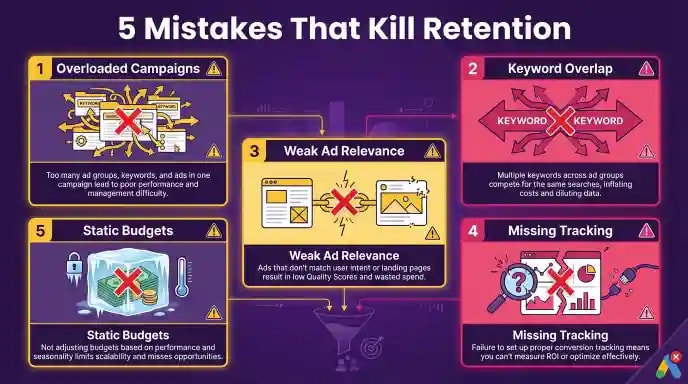
1. Overloaded Campaigns With No Clear Focus
Many agencies place multiple services, products, or locations into one large campaign. This creates confusion inside the account.
Why this hurts retention
- Ads can’t match specific search intent
- Budgets can’t be controlled by service priority
- Reporting becomes unclear for clients
Clients want to know which services are performing. If you can’t answer that, confidence drops.
How to fix it
Create campaigns based on clear themes such as branded terms, core services, or locations. Inside each campaign, keep ad groups tightly focused around one intent.
Why this hurts retention
- Ads can’t match specific search intent
- Budgets can’t be controlled by service priority
- Reporting becomes unclear for clients
Clients want to know which services are performing. If you can’t answer that, confidence drops.
How to fix it
Create campaigns based on clear themes such as branded terms, core services, or locations. Inside each campaign, keep ad groups tightly focused around one intent.
2. Keyword Overlap That Increases Costs
When similar keywords exist across multiple campaigns or ad groups, they compete against each other.
Why this hurts retention
- Cost per click increases
- Google struggles to choose the right ad
- Budget is wasted without clear gains
Clients only see higher spend, not the internal conflict.
How to fix it
Use clear keyword segmentation and apply negative keywords at campaign level. This prevents internal competition and improves efficiency.
Why this hurts retention
- Cost per click increases
- Google struggles to choose the right ad
- Budget is wasted without clear gains
Clients only see higher spend, not the internal conflict.
How to fix it
Use clear keyword segmentation and apply negative keywords at campaign level. This prevents internal competition and improves efficiency.
3. Weak Ad Relevance and Landing Page Mismatch
Sending all traffic to the homepage or using generic ad copy breaks the connection between search intent and experience.
Why this hurts retention
- Quality Score drops
- Conversion rates fall
- Bounce rates increase
Clients assume ads are ineffective, even when the issue is relevance. This relevance gap is why successful agencies treat PPC account structure as a client retention tool, often collaborating with specialized PPC partners to maintain consistent quality across all campaigns.
How to fix it
Ensure keywords, ads, and landing pages are aligned. Every major service should have its own ad message and a relevant landing page.
Why this hurts retention
- Quality Score drops
- Conversion rates fall
- Bounce rates increase
Clients assume ads are ineffective, even when the issue is relevance. This relevance gap is why successful agencies treat PPC account structure as a client retention tool, often collaborating with specialized PPC partners to maintain consistent quality across all campaigns.
How to fix it
Ensure keywords, ads, and landing pages are aligned. Every major service should have its own ad message and a relevant landing page.

4. Missing or Incorrect Conversion Tracking
Running Google Ads without proper conversion tracking is one of the biggest agency mistakes.
Why this hurts retention
- You can’t prove ROI
- Reports rely on clicks instead of results
- Clients question the value of the service
Without conversions, optimization becomes guesswork. Many agencies address this challenge by leveraging white-label PPC services that include proper conversion tracking setup and ongoing validation as standard practice.
How to fix it
Define 2–3 meaningful conversions such as form submissions or phone calls. Set up accurate tracking using Google Ads and Google Tag Manager, and verify everything before scaling.
Why this hurts retention
- You can’t prove ROI
- Reports rely on clicks instead of results
- Clients question the value of the service
Without conversions, optimization becomes guesswork. Many agencies address this challenge by leveraging white-label PPC services that include proper conversion tracking setup and ongoing validation as standard practice.
How to fix it
Define 2–3 meaningful conversions such as form submissions or phone calls. Set up accurate tracking using Google Ads and Google Tag Manager, and verify everything before scaling.

5. Static Budgets With No Performance Logic
Keeping the same budget across all campaigns ignores performance data.
Why this hurts retention
- High-performing campaigns run out of budget
- Low-performing campaigns waste spend
- Growth opportunities are missed
Clients expect smarter budget decisions.
How to fix it
Review performance regularly and shift budget toward campaigns delivering better cost per conversion. Let data guide spend, not habit.
Why this hurts retention
- High-performing campaigns run out of budget
- Low-performing campaigns waste spend
- Growth opportunities are missed
Clients expect smarter budget decisions.
How to fix it
Review performance regularly and shift budget toward campaigns delivering better cost per conversion. Let data guide spend, not habit.
Turning Structure Into a Retention System
Fixing one account is good. Fixing every account consistently is how agencies scale.
Best practices
- Run a full Google Ads account audit for every new client
- Perform quarterly structure reviews
- Monitor keyword conflicts, conversion health, and landing page relevance
Agencies without internal PPC audit capacity often use white-label digital marketing services to perform comprehensive account audits before client onboarding, ensuring clean foundations for optimization. For agencies managing multiple clients, partnering with white-label Google Ads specialists like BrandingBeez helps maintain quality without increasing internal workload.
Best practices
- Run a full Google Ads account audit for every new client
- Perform quarterly structure reviews
- Monitor keyword conflicts, conversion health, and landing page relevance
Agencies without internal PPC audit capacity often use white-label digital marketing services to perform comprehensive account audits before client onboarding, ensuring clean foundations for optimization. For agencies managing multiple clients, partnering with white-label Google Ads specialists like BrandingBeez helps maintain quality without increasing internal workload.
Conclusion: Structure Builds Trust Before Results Do
A strong Google Ads account structure makes optimization easier, reporting clearer, and performance more predictable. When agencies focus on structure first, results follow naturally.
Clients stay longer when they understand what’s working, why it’s working, and how growth is being managed. Account structure is not technical housekeeping it’s a retention strategy. Agencies implementing structured PPC management systems typically see measurable retention improvements documented case studies show how systematic account management directly impacts client lifetime value.
Clients stay longer when they understand what’s working, why it’s working, and how growth is being managed. Account structure is not technical housekeeping it’s a retention strategy. Agencies implementing structured PPC management systems typically see measurable retention improvements documented case studies show how systematic account management directly impacts client lifetime value.
FAQ
How long does it take to see results after fixing Google Ads structure?
Initial improvements may appear within weeks, but stable performance gains usually take 30–60 days.
Can smart bidding fix a poorly structured Google Ads account?
No. Smart bidding depends on clean structure and accurate conversion data to work effectively.
What is the first thing agencies should audit in Google Ads?
Conversion tracking. Without it, no optimization decision is reliable.
Does account structure affect Quality Score?
Yes. Poor structure lowers relevance, which increases cost per click and reduces ad visibility.
Ready to Get Started?
Contact our expert team to discuss how we can help grow your business with proven digital marketing strategies.